
A workshop facilitated by the National Library of the Maldives in collaboration with the Maldives National University and the Maldives Library Association was held at the National Library on 11 April 2019.
The workshop was aimed at librarians at senior positions as well as for those in administrative or management positions in charge of overall library operations. An important underlying focus of the workshop was to identify the skills required for efficient library service delivery, with a view to gathering information for the Bachelor of Arts in Library and Information Studies (BA-LIS) program being developed at the Maldives National University.
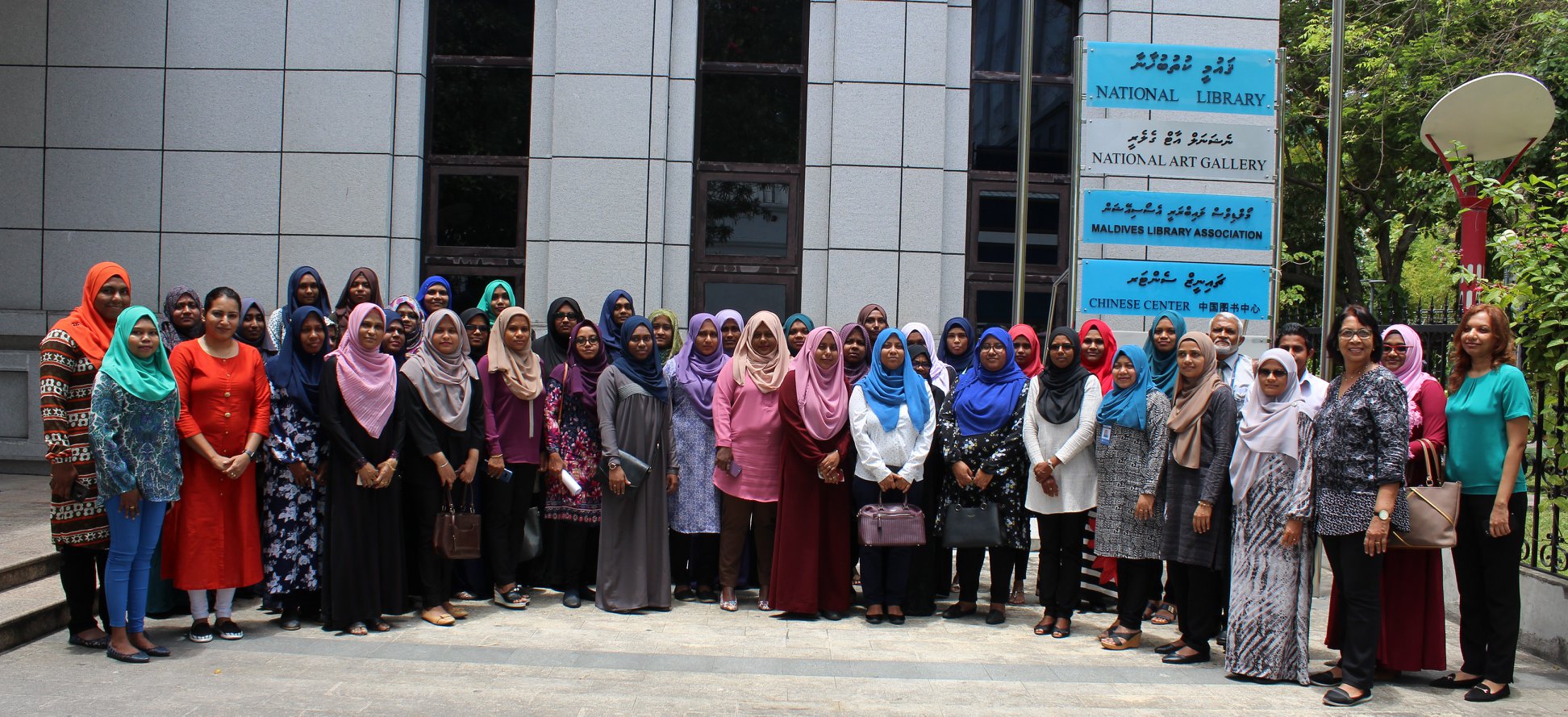
The call for interest was quite favorably received by many and registration had to be closed, owing to resource limitations, even though there were more LIS professionals interested in joining this event. A total of 48 participants from across the different range of libraries from the Maldives participated in this workshop.
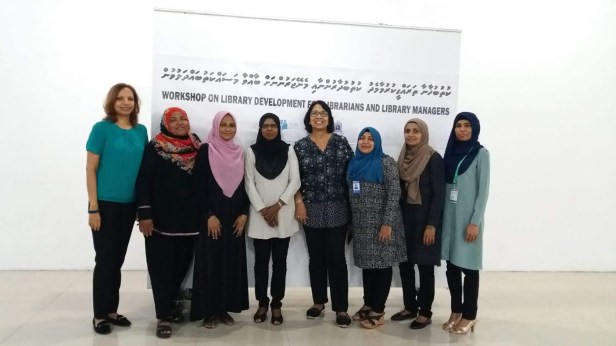
The sessions were delivered by:
- Ms. Mahasin Ahmed Didi, Director General, National Library
- Dr. Gina de Alwis, Independent Library & Information Management Professional/ Researcher, former Head of Library at Singapore Institute of Management
- Dr. Aminath Riyaz, Assistant Professor, The Maldives National University
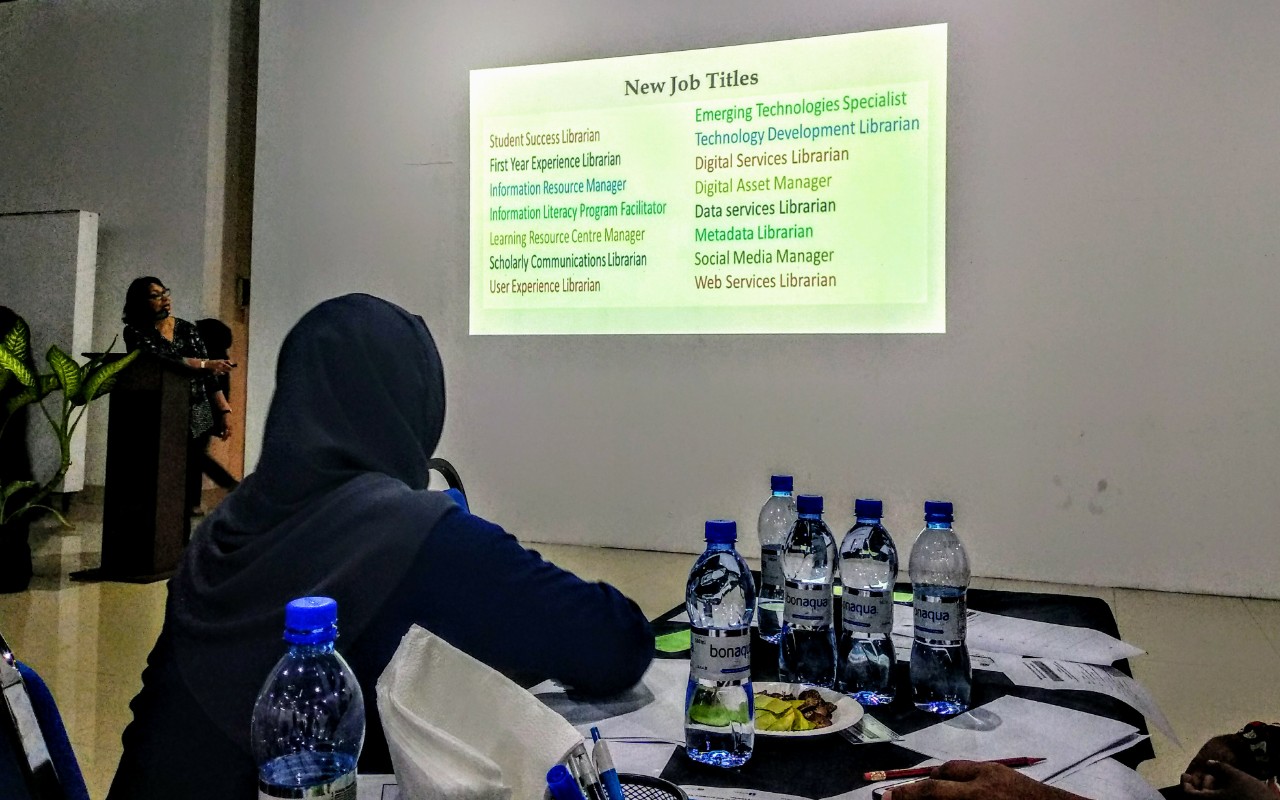

Workshop Program

A summary of the presentations and key areas highlighted in the workshop
- The role of libraries in schools and the challenges faced by these libraries: findings from a research study in the Maldives
Some significant highlights from the research were
– the lack of national standards or any document that highlight the criteria required for a school library, and
– it was found that many schools consider library more as an optional service,
– there was limited awareness on the functions and roles of the library within the school management and the policy-making level.
A number of recommendations were raised based on the research findings.
. - Innovative libraries: current & emerging trends in the use of library spaces and provision of services
The session was an eye opener about the new trends and innovations that continue to take place in libraries overseas in developed countries. These range from the transformation of physical space of library from book-centrist collections to open collaborative spaces, the changes from physical to online services and resources, the additional value-added services like sleep pods and cafes within libraries, the individual attention to clients through collaborations and partnerships with local communities, for example, student helpers on campus to assist freshmen in their learning journey, teaching skills that would help users’ in their learning journey or to enhance employability, etc.
. - Professional development of the LIS sector in other parts of the world and lessons for the Maldives were shared with the participants. The importance of assessing individual skills on a regular basis, identifying individual competencies and gaps, and seeking opportunities to advance the knowledge and skills was highlighted. Therefore, it was advised that participants develop a personal learning plan for themselves, especially to prepare for the expanded role of librarians in the current online environment.
. - The challenges of library development in the Maldives also highlighting the progress and opportunities available to enhance library services was shared with the participants. It is significant that to date, only about 6 LIS professionals have completed a university qualification in LIS overseas, which is limiting given the lack of education avenues locally. Information about library automation and digital library initiatives were shared, highlighting the challenges in sustainability of important initiative such as the Maldives Digital Library project.
. - Workshop session 1a: The library-related tasks the participants currently are involved in
The participants were asked to compile a list of tasks that they carry out in the libraries. The outcome is significant and highlights the range of skills librarians require in order to perform their work. The tasks listed were as follows:
– Circulation services; reference inquiries/information literacy; Accession / classification / cataloguing / serials management; Library orientation; Upgrading library services technically; Budget Planning; Conducting library events & programs; Automation & digitisation; Revising policies / procedures / Human Resource management; Acquisition (Group 1)
– Circulation/shelving; Cataloguing, classification, processing; Acquisition; Reference inquiries / Information literacy sessions; Library automation management; Digital Library management; Handling IT issues; Performance appraisal (Group 2)
– Acquisition: budgeting; Classification; Accessioning & cataloging; Processing; Circulation activities; Library Software; Orientation; Reference services; Donation activity (Group 3)
– Releasing the teachers due to absences (including emergency leave, sick leave, and/or to attend professional development programs); Fill in for the job of printing staff; Fill in for teacher shortage; Management work in the service area; Running public library programs; Library orientation; Children’s library activities (Group 4)
– Circulation-related changes; Technical works; Information literacy sessions; Human resources related tasks (Group 5)
– Developing policies/SOPs & rule and regulations; Accessioning/cataloging/processing; Information literacy sessions; Library development planning and initiative; Mending & repair; Budgeting & management of facilities; Supervising & mentoring other librarians; Human resource management & staff development activities; Book collection; Maintaining digital library (Group 6)
. - Workshop session 1b: The participants also shared the challenges/issues they face in performing the tasks
– Library space, resources, and budget limitations; Lack of standards & policies; Lack of qualified staff (Group 1)
– Budget constraints; Space planning; HR issues; Having to do other tasks not related to library work and therefore not having enough time for the effective running of the library; lack of trained LIS staff (Group 2)
– Limitations in budget and therefore not able to acquire appropriate resources/books; Limited availability of internet; Lack of necessary technical tools such as DDC; Lack of resources for effective processing library resources; Lack of software to automate library services and lack of trained staff who to implement such a software; Lack of support from school management in conducting library-related activities; Limitations in staff and student support in orientation sessions (Group 3)
– Misuse of library staff, such as the use of librarians to step in as relief teachers or to cover printing role; Due to lack of budget cannot keep with the public demand; High staff turnover (Group 4)
– Lack of staff for efficient service delivery; Having to use manual systems such as log books; Lack of tools such as DDC; lack of teaching/training skills to conduct information literacy sessions; Difficulty or “not comfortable” appraising staff (Group 5)
– Shortage of trained library staff; Financial constraints (Group 6)
. - Future of our libraries: educating our librarians
A brief look into the history of LIS education in the country, including higher education possibilities in LIS was also shared with the participants. The course structure of existing Advanced Certificate (ACLIS) in LIS which started in 2010 and the Diploma in LIS which started in 2012 was shared with the participants. The tentative second year and third year of the course structure for the BA-LIS was also shared. The Diploma year constitutes the first year of the Bachelor degree. To date, 86 students have graduated from the ACLIS while only 35 students graduated from the Diploma program.
. - Workshop session 2a: The developments participants would like to see in their libraries
The participants highlighted the following tasks/services:
– Implementation of a fully automated library system / RFID system / Security Gate / Kiosk system; Provide e-learning facilities with online databases (Group 1)
– Creation of digital library; Initiate library automation (including OPAC); Introduce self circulation system; Discovery services, E-services for researchers (Group 2)
– Information literacy sessions, reference services, Implementation of library automation with automated renewals, Security system, Digitization of local textbooks and use of Open education resources (Group 3)
– Utilization of computer lab to introduce information literacy activities such as education series and running quizzes; Provide group study rooms; Celebration of world book-day at national level; Provision of online books and other online resources for students; Establish a better dialogue and rapport between school management and libraries to recognize libraries as significant learning resources in the school learning environment (Group 4)
– Introduce library automation; Provide value-added services in the library such as photocopying, scanning, etc; Organize reading programs; Acquire online databases (Group 5)
– Initiate collaborations with stakeholders; Programs to enhance the image & understanding of libraries (Group 6)
. - Workshop session 2b: identifying the skill gap in implementing new services in the libraries
Apart from the highlighted skills on the tentative Bachelor of Arts in LIS course structure, additional skills that may be considered to be incorporated were identified as follows:
– Project management / change management / marketing,
– Classroom management or instructional psychology (or a similar subject) as many school libraries and academic librarians have to conduct training,
– Coaching & mentoring / conflict management / critical thinking
Workshop participants
- Aishath Abdulla
- Aishath Ali
- Aishath Musliha Adam
- Aishath Naeema
- Aishath Nazleen
- Aishath Yashfa
- Aishath Zukhura
- Aminath Hasma
- Aminath Leena
- Aminath Shazina
- Aminath Shehenaz (Aminath Ibrahim Didi)
- Aminath Shiuna
- Aminath Shukumaa
- Aminath Siyama
- Athiyya Shakeel
- Badhurunisaa
- Dhooma Ahmed
- Farhath Ahmed
- Fathimath Anoosha
- Fathimath Nafeeha
- Fathimath Nashath
- Fathimath Nashfa
- Fathimath Shahudha Mohamed Hameed
- Fathimath Shiham
- Fathmath Shafa
- Haleemath Shuhudha
- Hasmaa Shareef
- Hawwa Nasiha
- Hawwa Saeeda
- Hawwa Shiuna
- Hidhaayath Ahmed
- Hussain Haleem
- Laxmi Haawin
- Majida Ali
- Mariyam Gasim
- Mohamed Sarah
- Naadiya Saeed
- Nabaha Amir
- Nasheeda Abdul Raheem
- Naufa Hashim
- Nazla Saeed
- Neenaaya Ahmed
- Ryasa Umar
- Samahaa Rashaadh
- Sameeha Ahmed
- Yumna Rafeeq
- Zuhaira Ismail
- Zulhana Adam
These participants belong to the National Library, 15 school libraries, 3 academic libraries, and 1 special library. The libraries are:
- Ahmadhiyya International School
- Arabiyya School
- Centre for Higher Secondary Education
- Dhivehi Bahuge Academy
- Faafu Atoll Education Centre
- Ghaazee School
- Giyaasudheen School
- Hiriya School
- Huravee School
- Imaaduddin School
- Islamic University of Maldives
- Jamaaludheen School
- Lh Atoll School
- Maafushi School
- Maradhoo School
- MNU Library
- National Library
- Rehendhi School
- Thaa Atoll School
- Villa College
Reflections from the workshop
For the workshop facilitation, the participants were grouped into 6 groups, with one group consisting of experienced librarians and library managers (including leading teachers with the oversight of libraries). The other 5 groups consisted of staff who are working in a librarian position or those who have worked for a number of years in libraries. The groups were pre-determined so as to ensure staff from different libraries get a chance to have a discussion with staff from other libraries. The number of work experience of the participants range from 2 years to 36 years, with average years of experience at 9 years per representative at the workshop. We view this as a great combination of expertise within the field represented within the workshop.
The workshop was conducted from 8:45 am to 11:45 am, with quite intensive information exchange. One important highlight from the workshop was the need for further similar opportunities for information exchange and a platform to discuss issues faced by librarians. The range of content covered during the workshop also highlighted that the library and information services sector in the Maldives is still struggling with basic library functionalities like cataloging and resource acquisition and organization, with also an acute shortage of qualified LIS professionals in majority of the libraries represented at the workshop, let alone the rest of the almost 300 libraries in the Maldives.
It was unfortunate that there was not enough representation at the workshop from the senior school officials who have the responsibility to oversee the development of libraries. This is an area that needs to be looked into and collaborated with the Ministry of Education.
The overall feedback received for the workshop was quite favorable with requests for more frequent workshops and events of a similar nature. The importance of organizing and advertising for similar events with at least a few weeks of advance notice was highlighted. Similarly, there were requests to ensure information about such events was disseminated throughout the country.
 Maldives Library Association